History of Advertising
The History of advertisement dates back to 4000 BC. Egyptians used papyrus to make sales messages and wall posters. Wall or rock painting for commercial advertising is another manifestation of an ancient advertising form, which is present to this day in many parts of Asia, Africa, and South America. History tells us that Out-of-home advertising and billboards are the oldest forms of advertising.
As the economy expanded during the 19th century, advertising grew alongside. In the early 1920s, the first radio stations were established which started selling sponsorship rights in small time allocations to multiple businesses throughout their radio station's broadcasts. The late 1980s and early 1990s saw the introduction of cable television. As cable and satellite television became increasingly prevalent, specialty channels emerged, including channels entirely devoted to advertising, such as QVC, ShopTV Canada etc.
Online Advertising
With the advent of the ad server, marketing through the Internet opened new frontiers for advertisers and contributed to the "dot-com" boom of the 1990s. Entire corporations operated solely on advertising revenue. At the turn of the 21st century, a number of websites including the search engine Google, started a change in online advertising by emphasizing contextually relevant, unobtrusive ads intended to help, rather than inundate, users.
One major benefit of online advertising is the immediate publishing of information and content that is not limited by geography or time. Another benefit is the efficiency of the advertiser's investment. Online advertising allows for the customization of advertisements, including content and posted websites. The growth of internet attracts the attention of advertisers as a more productive source to bring in consumers. The advantage consumers have with online advertisement is the control they have over the product, choosing whether to check it out or not.
Worldwide Internet Penetration
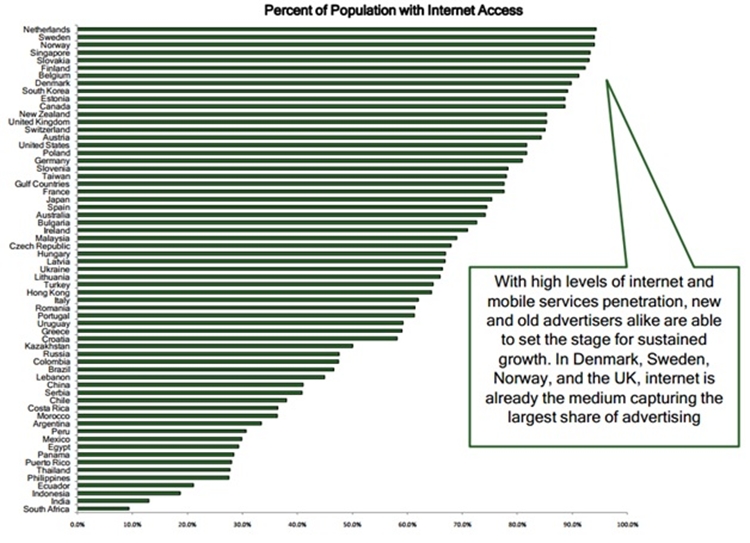
Following picture tells the story of the present and future of online advertising business. In many developed countries, even today it has become the most prominent part of entire advertising industry. Under developed and developing countries also will follow the same path as the internet penetrations increases in those countries.
Source: Magna Global, 2011 Advertising Forecast
Advertisement Revenue Forecast
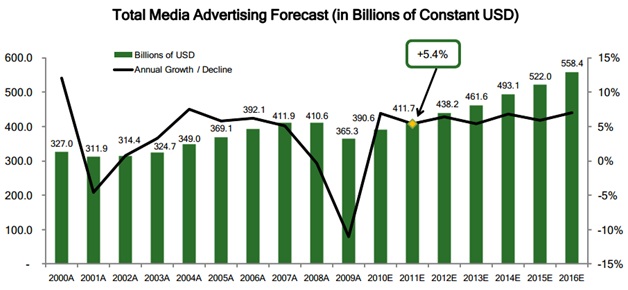
Before understanding the business potential of online advertisement it's important to know the business strength of entire advertisement industry. In the world of fierce competition total revenue from advertising business in 2011 was approximately $400 billion. This is expected to grow up to $600 billion by 2016. Following picture tells the story of the growth of advertisement business revenue.
Source: Magna Global, 2011 Advertising Forecast
Internet Advertising Forecast
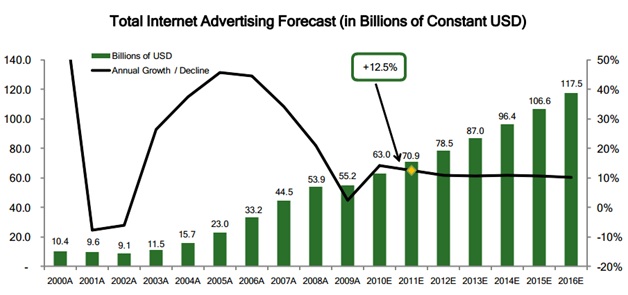
Now the following picture tells that the internet advertising has significantly big share in the entire advertisement industry. In 2011 it touched approximately $70 billion and expected to grow fast up to $117 billion in 2016. There is a clear growth in the world wide internet advertisement revenue.
Source: Magna Global, 2011 Advertising Forecast
Affiliate marketing
Affiliate marketing is a type of marketing in which a business rewards one or more affiliates for each customer brought about by the affiliate's own marketing efforts. The industry has four core players: the merchant, the network (which takes care of the payments), the publisher (also known as 'the affiliate'), and the customer. In the market there are secondary tier of players, including affiliate management agencies, super-affiliates and specialized third party vendors.
Affiliate marketing overlaps with other Internet marketing methods to some degree, because affiliates often use regular advertising methods. Those methods include search engine optimization (SEO), paid search engine marketing (PPC - Pay Per Click), e-mail marketing etc.
Affiliate marketing has grown very quickly since its inception. The e-commerce websites, became an integrated part of the overall business plan and in some cases grew to a bigger business than the existing offline business. Currently the most active sectors for affiliate marketing are the adult, gambling, retail industries and file-sharing services. The three sectors expected to experience the greatest growth are the telecom, finance, and travel sectors. Soon after these sectors came the entertainment and Internet-related services sectors.
Websites and services based on Web 2.0 concepts - blogging, for example - have impacted the affiliate marketing world as well. Web 2.0 platforms have also opened affiliate marketing channels to personal bloggers, writers, and independent website owners. Regardless of web traffic, size, or business age, programs allow publishers at all levels of web traffic to place advertisements in blog posts.
Ethics
Online advertising consists of a range of types of advertising, some of which are deployed ethically and some are not. Some websites use large numbers of advertisements, including flashing banners that distract the user. Websites that unethically use online advertising for revenue frequently do not monitor what advertisements on their website link to, allowing advertisements to lead to sites with malicious software or audience-inappropriate material. The use of technologies like Adobe Flash in online advertising has led to some users disabling it in their browsers, or using browser plug-ins like Adblock or NoScript.